
Create standout explainer videos for your record label
Discover how independent musicians and record labels can create standout explainer videos using AI tools and proven strategies, without a big budget.
Create standout explainer videos for your record label
TL;DR:
- AI tools enable musicians and labels to produce professional explainer videos cost-effectively in 2026.
- Effective explainer videos communicate messages clearly within 60-90 seconds and include a strong hook.
- Treating video as a modular, systematized asset across platforms increases engagement and audience retention.
Forget the days when a polished explainer video meant hiring a production crew and spending upwards of £4,000. In 2026, a small label or independent musician can create a compelling, professional-looking explainer video with tools that cost less than a night out, sometimes nothing at all. AI-driven platforms, smart templates, and music-sync technology have genuinely levelled the playing field. This guide walks you through the tools worth using, the formats that convert, the messaging mistakes that kill engagement, and the strategies that the sharpest labels are quietly deploying right now.
Table of Contents
- Why explainer videos matter for record labels and musicians
- Choosing the right tools: AI platforms and video templates
- Crafting videos that convert: Format, messaging, and music
- Common pitfalls and how to avoid them
- Original perspective: Why the most successful record labels use explainer videos differently
- Take your music promotion further with Music Video Marketplace
- Frequently asked questions
Key Takeaways
| Point | Details |
|---|---|
| Explainer videos drive engagement | Short, music-synched explainer videos are essential for capturing attention and boosting song discovery. |
| AI tools make video creation accessible | Platforms like Pictory and Animoto offer musicians and labels affordable, user-friendly ways to produce quality videos. |
| Strong hooks and brand consistency matter | Starting videos with a quick hook and using custom music ensures retention and boosts your brand identity. |
| Avoid common production mistakes | Steer clear of overused music, visual clutter, and unclear calls to action for maximum impact. |
| Innovative strategies lead the market | Micro-interactions, personalisation, and modular vertical formats set top-performing labels apart. |
Why explainer videos matter for record labels and musicians
Explainer videos are not just promotional fluff. For musicians and labels, they serve as the fastest, most shareable way to communicate your sound, your story, and your offer to a cold audience. A text post or static image asks the viewer to do the imaginative heavy lifting. A well-made explainer does it for them in under two minutes.
The numbers back this up. Audiences consistently retain more information from video than from text, and platforms like YouTube and TikTok actively favour video content in their discovery algorithms. Musicians using explainer videos to introduce new singles, promote merchandise, or explain their creative process see measurably higher engagement than those relying solely on still imagery or written captions.
For record labels specifically, the stakes are higher. You are not just marketing one artist. You are building a brand identity that needs to communicate clearly and consistently across multiple releases, multiple artists, and multiple platforms. An explainer video that captures what your label stands for can do that work repeatedly, without you paying anyone to recreate it each time.
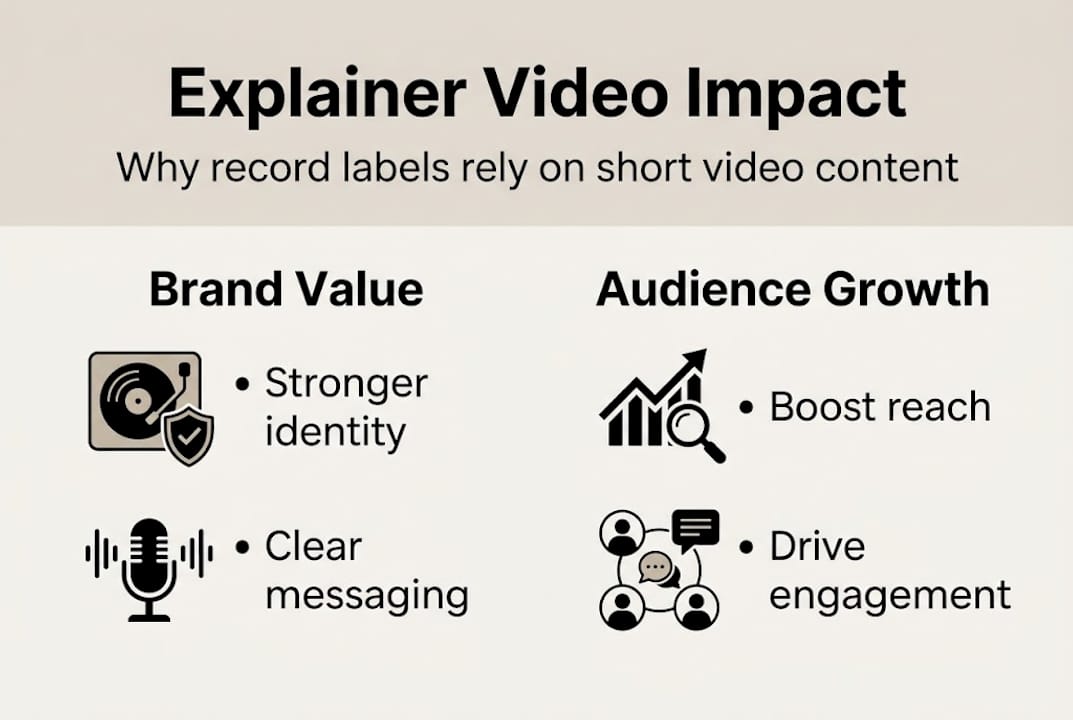
Platforms like TikTok and YouTube are now primary discovery channels for new music. Boosting video engagement on these channels is directly tied to how quickly your content hooks a viewer and how well it communicates something worth sharing. A great explainer video does both.
Cost used to be the barrier. Traditional production costs ranged from £4,000 to well over £10,000 for a polished result. Now, AI-powered tools let independent musicians and labels create results that rival that quality without the budget. The barrier has shifted from money to knowledge, which is exactly what this guide addresses.
Here is what explainer videos can do for your music marketing:
- Introduce a new release with context that streaming platforms alone cannot provide
- Build label brand identity through consistent visuals, tone, and messaging
- Drive traffic from social media directly to streaming links or landing pages
- Improve discoverability through platform algorithms that prioritise video content
- Reduce repetitive outreach by letting one video do the explaining for you
For YouTube music videos on a budget, the key insight is that production value matters less than clarity of message and strength of hook. A video that communicates clearly and quickly will always outperform an expensive one that meanders.
Choosing the right tools: AI platforms and video templates
With the market flooded with video creation platforms, choosing the right one depends on what you actually need. Here is a breakdown of the most relevant options for musicians and labels in 2026.
| Platform | Best for | Price range | Key feature |
|---|---|---|---|
| Pictory | Turning scripts into videos | Free to £19/month | AI script-to-video |
| Animoto | Quick promo clips | Free to £8/month | Music sync, drag-and-drop |
| PlayPlay | Brand-consistent content | From £0 trial | Template-driven branding |
| Videobolt | Music visualisers | From £10/month | Animated music visuals |
| simpleshow | Story-driven explainers | Free basic tier | Whiteboard animation style |
Distinctive benefits for musicians vary between these platforms, so your choice should match your workflow. If you are dropping a new single and need a quick visual to pair with it, Animoto or Videobolt gets you there fastest. If you are building a label brand narrative, PlayPlay or Pictory gives you more control over tone and messaging.
When thinking about video content strategies for your releases, consider the platform you are publishing on before you build. Vertical formats perform better on TikTok and Instagram. Widescreen works for YouTube. Most of the tools above support both.
For explainer videos specifically, the 2026 video marketing trends point clearly toward AI avatars, animated text overlays, and music visualisers as the formats generating the most engagement. These are no longer novelties; they are expected.

Pro Tip: Keep your explainer video between 60 and 90 seconds. Any shorter and you lose the ability to communicate your full message. Any longer and drop-off rates spike sharply. This sweet spot applies across YouTube, Instagram, and TikTok.
On visuals in rap music, the most effective videos pair audio peaks with visual moments precisely, something the best templates already account for if you choose wisely.
Key features to look for when choosing your platform:
- Music sync tools that align visuals automatically to your track’s beats
- Brand kit support so your colours, fonts, and logo stay consistent across every video
- Export options for multiple aspect ratios without having to rebuild the video
- Template libraries that are actively updated to reflect current aesthetic trends
Crafting videos that convert: Format, messaging, and music
Having the right tool is only part of it. What you put into that tool determines whether your video drives action or gets scrolled past in half a second.
Here is the structure that consistently performs:
- Open with a 3-second hook. On TikTok especially, 3-second hooks are non-negotiable. Use a bold visual, an unexpected lyric snippet, or a direct question that targets your listener’s desire.
- State your value clearly within 10 seconds. Tell the viewer what this video is about and why it matters to them. No preamble.
- Synchronise your visuals with your track’s strong points. Drop cuts and transitions on beats. Let the music carry emotional momentum while the visuals reinforce your message.
- Spotlight your unique selling point. What makes this single, this artist, or this label different? That answer belongs in the middle of your video.
- End with a single, clear call to action. One action. Stream it, follow us, sign up, visit the link. Multiple CTAs dilute each other.
| Video element | Recommended approach | Common mistake |
|---|---|---|
| Opening hook | Bold visual or provocative question | Starting with your logo or label name |
| Music choice | Original track or on-brand licensed audio | Generic royalty-free filler |
| Pacing | Cut on beats, match energy to message | Uniform, unmotivated cuts |
| Call to action | One clear directive | Multiple competing asks |
Pro Tip: When reviewing video campaign examples from other independent artists, notice how the best ones treat the first three seconds as if nothing else exists. That discipline is what separates videos that get shared from those that get skipped.
For YouTube video best practices, remember that autoplay often begins without sound. Your opening visual needs to communicate something compelling even in silence, which makes text overlays and strong imagery essential from the very first frame.
The guidance around hip-hop marketing strategies is instructive here: the most successful campaigns treat the video not as an afterthought but as the primary marketing asset.
Common pitfalls and how to avoid them
Even musicians with genuine talent and a decent tool can create explainer videos that flatly do not work. Here is where most go wrong.
Brand inconsistency is the most widespread issue. When your video uses fonts, colours, or a visual language that clashes with your other content, viewers feel the disconnect even if they cannot articulate why. It erodes trust before you have said a word.
Overused music is a close second. Reaching for the same royalty-free tracks that thousands of other creators use signals that you have not thought carefully about your identity. As the guidance around avoiding overused music makes clear, brand consistency and original audio choices are directly linked to viewer retention.
“The fastest way to lose a viewer is to show them something they have already seen a hundred times. Original visuals and original music are not a luxury; they are the baseline for being noticed.”
Here are the most common pitfalls and their fixes:
- Information overload: One video, one message. If you are promoting a single, do not also explain your label’s history and announce a tour.
- Unclear CTA: Test your video on someone unfamiliar with your work. If they cannot tell you what action you want them to take, rewrite the ending.
- Wrong format for platform: A widescreen video posted to Instagram Stories will be cropped unpredictably. Always export for the platform you are targeting.
- Neglecting captions: A large proportion of social video is watched without sound. Captions are not optional; they are essential.
For creative video content ideas, the fix for most of these issues is planning before production. Map out your message, your platform, and your CTA before you open any tool. The video itself takes minutes once you know what you are making.
The broader case for why video boosts song exposure in 2026 is well established. The labels seeing the biggest returns are those treating video as a system, not a one-off task.
The importance of music videos for hip-hop fans illustrates a wider truth: audiences across genres now expect visual content to accompany music, making explainer videos a baseline expectation rather than a bonus.
Original perspective: Why the most successful record labels use explainer videos differently
Most labels treat explainer videos as standalone assets. Make one, post it, move on. That thinking leaves an enormous amount of value untouched.
The labels genuinely winning in 2026 build what you might call a modular video system. They create one core explainer and then cut it into vertical clips for TikTok, square formats for Instagram, and a longer version for YouTube, all from the same session. Nothing is wasted. Every platform gets content that fits its native behaviour.
Current 2026 trends confirm that AI personalisation and micro-interactions, small animated responses to viewer behaviour, are transforming retention rates. Most independent musicians have not started using these yet, which means there is a real competitive window open right now.
Understanding why video content matters is one thing. Treating it as a modular, repeatable system rather than a one-time effort is what separates labels that grow from those that stay static. The educational video benefits for artists extend beyond promotion into building genuine audience relationships that last beyond a single release cycle.
Take your music promotion further with Music Video Marketplace
If this guide has shifted how you think about explainer videos, the logical next step is putting that thinking into action without wasting time on trial and error.

Music Video Marketplace is built specifically for independent musicians and record labels who want to move fast. You can create a long-form video in minutes, upload it directly to YouTube, and launch an ad campaign for your song without needing a marketing team behind you. Whether you are releasing your first single or scaling a roster of artists, the platform gives you the tools to act on everything covered in this guide straight away.
Frequently asked questions
What is the optimal length for a music explainer video?
The most effective explainer videos run between 60 and 90 seconds, a range that gives you enough time to communicate your message without triggering viewer drop-off at the midpoint.
Can independent musicians create professional explainer videos without a big budget?
Absolutely. AI-powered platforms now offer free or low-cost tiers that produce results comparable to traditional production at a fraction of the cost.
What should be avoided when using music in explainer videos?
Steer clear of overused royalty-free tracks that signal a lack of creative investment. Always align your music choices with your brand identity to maintain originality and keep viewers watching.
How do vertical video formats improve social media performance?
Vertical videos fill a smartphone screen naturally, removing friction for the viewer. Vertical formats consistently outperform widescreen on TikTok and Instagram because they match how people actually hold their phones.
Recommended
- Why musicians use explainer videos to promote | Music Video Marketplace Blog
- Create DJ promo videos that drive engagement and bookings | Music Video Marketplace Blog
- Creative video content ideas for producers: boost music promotion | Music Video Marketplace Blog
- Creative video campaign examples for independent musicians | Music Video Marketplace Blog
- How a creative production company elevates brand storytelling
Read next
 Explaining music release strategies: your 2026 guideMaster the art of explaining music release strategies. Your 2026 guide covers pre-release planning, launch tactics, and post-launch retargeting.
 Fan engagement strategies that power your music marketingDiscover the vital role of engagement in music marketing. Learn effective strategies to connect with fans, boost sales, and enhance your reach.
 Guide to music video teasers: 2026 strategiesUnlock the secrets of promotion with this guide to music video teasers. Boost engagement on social media and build anticipation for your release!
 Explainer content for musicians: engage and growDiscover the power of explainer content for musicians. Engage your audience and grow your following with creative, accessible video solutions.
Turn the idea into a finished music video.
Drop your track into the Studio and build your visual in minutes.