
Music Video Styles: Types, Aesthetics and How to Choose
The main music video styles, what shapes a video's aesthetic, and how artists, labels and managers pick a look that fits the song and the release.

Music Video Styles: Types, Aesthetics and How to Choose
Most music videos are built from three basic forms: performance, narrative and concept. Everything else, from lyric videos to visualisers, is a variation or a blend. The style you choose matters less than whether it fits the song and the artist, and whether you can release it fast enough to use it. A ready-made, human-made video that you customise with your own audio and branding on Music Video Marketplace gets you a finished, YouTube-ready video without a custom shoot.
This guide is for artists, labels, managers, DJs and producers who need to decide what a video should look like. It covers the styles, what makes up an aesthetic, how genre shapes the look, and how to settle on a concept.
MusicvideomarketplaceCreate a YouTube-Ready Music VideoMusicvideomarketplace helps musicians create a long-form video in minutes for YouTube and build an ad campaign for their song.VisitTL;DR
- Performance, narrative and concept are the three core forms. Most videos mix them in different proportions.
- Lyric videos, dance videos, animation, live sessions and visualisers are common secondary forms, often cheaper and quicker to release.
- Aesthetic is the sum of colour, lighting, camera work, editing and recurring imagery. Coherence matters more than illustrating every lyric.
- Genre carries visual codes audiences already read, so match the look to the genre and the artist’s identity.
- A ready-made video you customise can give you a professional look quickly, without commissioning a shoot.
Table of Contents
- The three core music video styles
- Other types you will meet
- What makes up a video’s aesthetic
- Genre sets expectations
- Most videos are hybrids
- How to choose a style for your song
- Why a ready-made video can be the right style decision
- Get a finished video for your release
- Our perspective
- FAQ
- Sources
The three core music video styles
An academic lesson on music video cinematography describes most videos as combinations of three basic forms: performance, narrative and concept. Knowing which one you are making tells you what the video needs and what it will cost in time.
Performance videos
The artist sings or the band plays, on a set, on location or in front of an audience. This is the most direct connection with the viewer and the easiest form to cut to the music. It is also the oldest. Researcher Emily Caston traces performance videos to mid-1960s films such as A Hard Day’s Night and calls the mimed performance the genre’s “core deceit”. British examples she cites include The Cure’s “Close To Me” (1985) and Blur’s “Song 2” (1997).
Performance suits artists who want to be recognised. Media studies material notes that performance videos raise an artist’s profile by showing the faces behind the music. That makes this form a natural choice for a debut single or a new project.

Narrative videos
A narrative video tells a story. It may follow the lyrics literally or take loose inspiration from them, and the artist often acts in it, with performance sections intercut. The camera and lighting approach is closer to a short film: coverage of scenes and lighting that serves the story.
Narrative deepens the emotional link to a song, which is why it suits ballads, singer-songwriters and tracks with a clear lyrical situation. It asks more of a video: locations, actors and continuity.
Concept videos
A concept video is built around one visual idea: a single-take choreography, a visual effect, an unusual location, a striking colour world or a camera trick. The same lesson describes these as designed around one idea, often with precise special lighting. Media studies material says unique concept visuals help a video stand out by surprising the viewer.
Concept suits tracks where a hook, a mood or a texture is the point, and where you want a thumbnail that is instantly distinctive.
Other types you will meet
Beyond the three core forms, artists regularly release:
- Lyric videos: the words on screen, styled to the song. Quick to make and useful between major releases.
- Dance videos: choreography filmed mostly in wide shots with even lighting so the movement reads clearly.
- Animation: stop motion or digital. The UK’s Pearson BTEC specification for music video production lists animation alongside interpretative, narrative, impressionist and surrealist styles, as well as pastiche, parody and homage.
- Live session videos: several unobtrusive cameras capturing a real performance, as opposed to a mimed one. Caston contrasts the mimed form with genuinely live videos such as Joy Division’s “Love Will Tear Us Apart” (1980).
- Visualisers: locked or looping, high-contrast graphic images, often used for catalogue tracks and quick releases. Our guide to audio reactive visuals covers how they work.
The same Pearson specification also names conventions worth knowing: interpreting lyrics, extending or reinforcing the song’s meaning, allusions to other artists, cutting to the beat, miming and lip sync, and camera movement.
What makes up a video’s aesthetic
Style is the form. Aesthetic is the look and feel inside it. Five things do most of the work.
Colour
Colour can be symbolic, and it appears in costume, make-up, location and props. A Yale National Initiative teaching unit notes that black and white is often used to mark flashbacks. A single dominant colour world is one of the quickest ways to make a concept video memorable.
Lighting
The same unit explains that key, fill, back, top, side and bottom lights each carry meaning, and that lighting signals genre: natural light is associated with country videos, strobe and colourful lights with dance pop and hip hop, and darker, high-contrast lighting with grunge. If your lighting contradicts your genre, viewers feel it before they can say why.
Camera work
Locked-off frames feel controlled and composed. Handheld feels immediate. In a Sound on Sound piece on editing music promos, JG Harding points out that every shot in Glasvegas’s “Flowers And Football Tops” has motion at roughly the same speed, which keeps a slow, sombre song moving.
Editing
Cutting on the beat is the default, but cutting in or out of sync pushes the viewer’s focus between sound and image, as the same article explains. Caston’s study of British music video editors, drawing on work for The Chart Show, The Box and MTV, discusses graphic matches and disjunctive jump cuts as signature tools.
Recurring imagery
A mirror, a doorway, a silhouette. Repeated symbols give a video a spine. Open Music Business argues that a video can have beautiful images and still feel “visually anonymous” if they do not share a governing idea, and that the goal is coherence rather than illustrating every lyric.
Genre sets expectations
Every genre develops visual codes that audiences learn to recognise. One overview of the visual codes of genre says pop videos often use bright palettes, high-key lighting, fashionable costumes, choreography and fast editing around the star image, while indie pop may favour natural lighting and everyday locations. It adds that rock stresses authenticity and rebellion, rap and grime explore identity and status, and EDM prioritises spectacle and energy.
The codes are a starting point, not a rule. The Guardian reported that grime’s visual identity grew out of real London neighbourhoods. Director Keefe described how putting grimey visuals on a pop tune makes it “a little bit rebellious”. Meeting the code builds recognition. Bending it adds tension. Either way, you should know which one you are doing.
| Your situation | Style that usually fits | Why |
|---|---|---|
| Debut single, building a face | Performance | Puts the artist on screen and builds recognition |
| Lyric-led ballad | Narrative | Gives the words a situation to live in |
| Club or electronic track | Concept or visualiser | Texture and energy carry the song |
| Catalogue track or album deep cut | Lyric video or visualiser | Fast to release and keeps the song working |
| Dance or pop single | Dance-led performance | Movement and star image drive the appeal |
Most videos are hybrids
Media studies material points out that combining styles into hybrid forms engages audiences on different levels, which is why most videos mix conventions. Harding’s advice in Sound on Sound is practical: build on a solid performance and place purposeful atmospheric and cutaway shots through it, so the story unfolds bit by bit, paced by the performance.
A performance video with one strong colour world is a hybrid. So is a narrative with intercut studio shots. Think of the three forms as dials rather than boxes.
How to choose a style for your song
Open Music Business suggests building the visual system around the song’s emotional centre, the artist’s identity and where the video will be seen, following a route from emotion to behaviour, environment, light and colour, camera language, a recurring symbol and finally a distribution asset. Its example: for “confidence that is beginning to crack”, the light moves from bright and even to harder shadows, and the camera drifts away from locked compositions.
In practice, ask five questions.
- What does the song feel like in one phrase? Write it down. This is your brief.
- Who is the artist on screen? Decide early whether they appear or perform. Directors Mathy and Fran told Musicbed that knowing basic boundaries in advance, such as whether the artist wants to perform in the video, helps.
- Where will it be watched? A YouTube long-form video, a vertical clip and an ad each ask for different framing and pacing.
- What can you release, and when? Release timing often decides between a bespoke shoot and something you can finish this month.
- Does it look like you? Framing, movement style, recurring materials and consistent graphics make an artist recognisable across videos, thumbnails and profiles.
How labels have traditionally planned concepts
Caston’s research on British music video production in the late 1990s describes the traditional route. A label’s video commissioner shortlisted ten to twenty directors, each of whom wrote a treatment of half a page to two pages, and the artist, manager and marketing team chose the favourite. It is a sound process, and it is built around a budget and a schedule that many independent artists do not have.
A first-time UK filmmaker profiled by Creative Cardiff used a spreadsheet script where every second of the song was a row, with columns for visuals and matching lyrics. Her advice: do not overthink first ideas, and always storyboard.
Why a ready-made video can be the right style decision
The route above assumes a shoot. If your priority is speed, consistency and a professional finish, a browsable catalogue changes the question from “what can we afford to film?” to “which finished look matches this song?”
Our videos are produced by professional filmmakers specifically for music. They are not made with AI or generic stock footage, a distinction we explain in our guides to AI versus human music videos and stock footage versus custom video. You can compare the trade-offs in premade versus custom music videos, or see how the approach stacks up against hiring a director.
Get a finished video for your release
On Music Video Marketplace you browse human-made, ready-to-edit, full-length music videos, customise one with your audio and branding, and export it YouTube-ready. You can also generate short social clips and launch an ad campaign for your song.
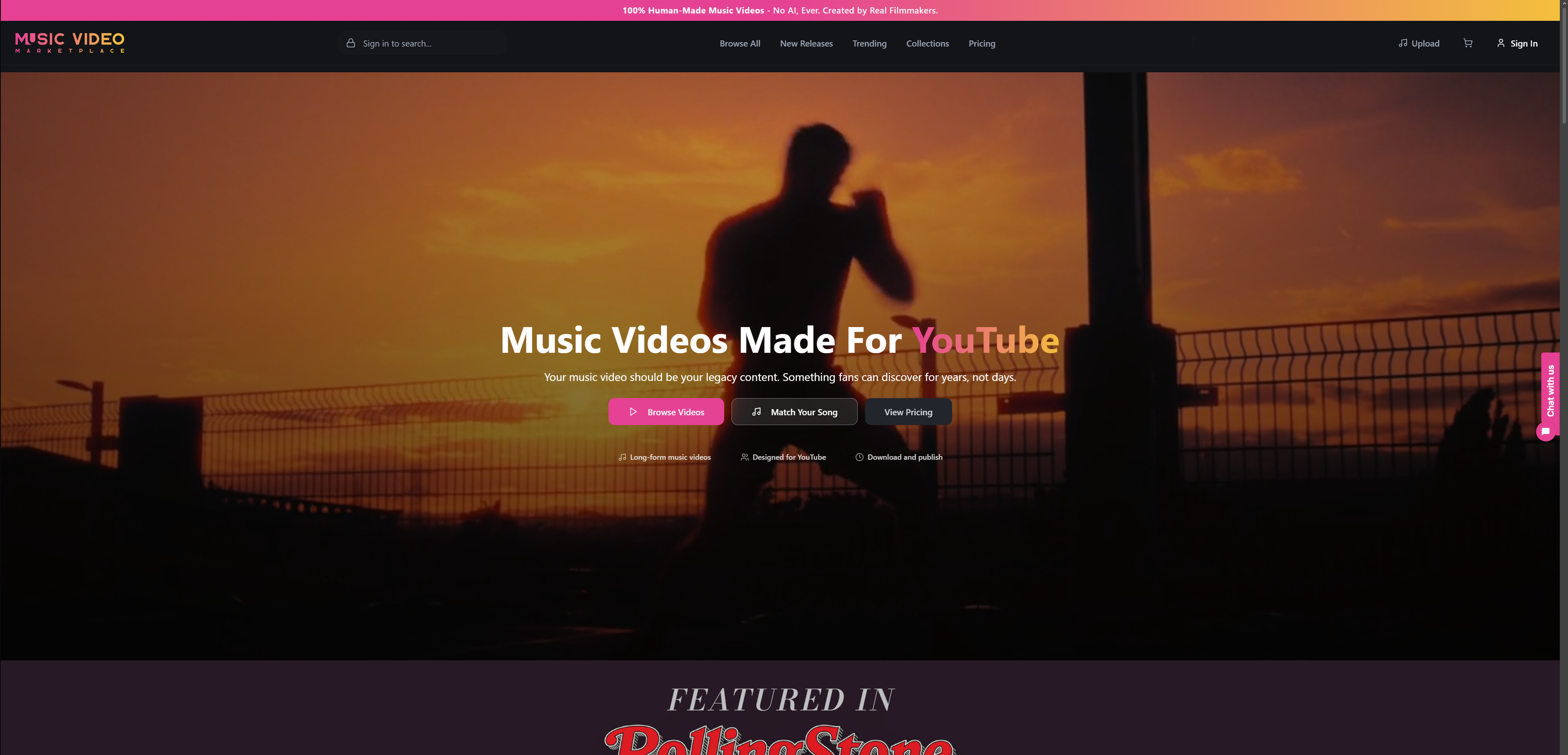
Membership is £19.99 per month, and recurring extra videos are £9.99 per month per video. Full details are on the pricing page, and you can explore the music video catalogue to see which looks suit your genre.
Our perspective
Styles are tools, not labels. The artists who stand out are not the ones who picked the “right” category. They are the ones whose video looks like it belongs to the song.
That is why we focus on human-made videos. Every video in our catalogue is produced by professional filmmakers specifically for music, so the colour, lighting and camera decisions were made by people who understand how a song moves. Nothing is generic stock footage, and nothing is generated by AI.
We also think speed is part of aesthetics. A strong video released while the single is fresh is worth more than a perfect one that arrives after the moment has passed. Customisation with your own audio and branding lets you keep a consistent identity across releases without a custom shoot each time.
Pick the form that fits the song, keep one governing idea, and get it in front of listeners.
Music
FAQ
What are the main types of music videos?
The three core types are performance, narrative and concept videos. Common additions are lyric videos, dance videos, animation, live session videos and visualisers. Most real videos blend several of these.
What is a music video’s aesthetic?
It is the overall look and feel created by colour, lighting, camera work, editing and recurring imagery. A good aesthetic gives viewers a visual way into the song and makes the artist recognisable across videos, thumbnails and clips.
How do I match a video style to my genre?
Start with the visual codes your audience already reads: bright, choreographed visuals for pop, spectacle for EDM, real locations for grime, natural light for indie. Then decide whether to follow those codes or deliberately bend them, and keep the result consistent with the artist’s identity.
Can independent artists get a professional-looking video quickly?
Yes. Choosing a ready-made, human-made video and customising it with your own audio and branding avoids the treatment, casting and shooting stages. You can export it for YouTube and cut short clips for social media from the same video.
Sources
- Music video cinematography: forms and process (HSM University)
- Unit 29: Music Video Production (Pearson BTEC)
- Power To The People: British Music Videos 1966 - 2016 (UWL)
- Editing dossier (UWL)
- Music Videos and Genre (Media Studies)
- Unit 22.01.04 (Yale National Initiative)
- Music Video Aesthetics (Open Music Business)
- The Visual Codes of Genre
- Attack the block: how grime’s visuals went pop (The Guardian)
- Video Editing: Music Promos (Sound on Sound)
- Kick, Bollocks and Scramble (UAL Research Online)
- Creative Firsts: Creating a music video for the first time (Creative Cardiff)
- The Art of the Music Video: A Conversation with Mathy and Fran (Musicbed)
Recommended
Read next
 Music Video Templates: When Free Beats a £500 UK ShootSee how music video template costs compare with UK production bands, when free assets work, and which licence fits a single, social clip, or ad campaign.
 Music Video Turnaround Time: How Long It Really TakesHow long does a music video take from commission to upload? Realistic UK timelines for custom shoots and ready-made videos, plus how to plan your release.
 Premade vs Custom Music Videos: Which Should You Choose?Premade or custom music video? Compare cost, speed, creative control and UK rights, and see which suits your release, budget and deadline.
 Music Video Revision Policy: What to Agree Before You StartHow music video revision policies work in the UK: rounds, scope changes, sign-off and deemed acceptance, plus how ready-made videos cut the need for revisions.
Turn the idea into a finished music video.
Drop your track into the Studio and build your visual in minutes.