
What is digital music promotion? A guide for indie artists
Discover what digital music promotion is and how it can help indie artists build real audiences and get their music heard. Start your journey today!
What is digital music promotion? A guide for indie artists
TL;DR:
- Effective digital music promotion relies on a structured, multi-channel system that builds consistent visibility and audience engagement over time. Adhering to platform rules and a steady release schedule enhances organic growth, while shortcuts like buying streams risk long-term damage. Artists who focus on discipline, data-driven strategies, and quality content development achieve sustainable success rather than fleeting fame.
Many independent musicians pour everything into recording a great track, only to watch it disappear into the noise within days of release. The assumption is that going viral will fix everything, but that belief leads countless talented artists down a frustrating dead end. Digital music promotion is far more structured and sustainable than most people realise, and understanding how it actually works is what separates artists who build real audiences from those who keep wondering why nobody is listening.
Table of Contents
- Understanding digital music promotion
- How release schedules power your promotion
- Platform rules: what to avoid and why it matters
- Maximising impact on YouTube and streaming platforms
- What most indie artists miss about digital promotion
- Next steps: Get your music seen and heard
- Frequently asked questions
Key Takeaways
| Point | Details |
|---|---|
| Consistent release strategy | Regularly releasing music keeps audiences engaged and algorithms interested. |
| Avoid fake growth tactics | Stream-buying and follower manipulation risk bans and hurt long-term promotion. |
| YouTube growth matters | Focus on YouTube optimisation for steady, organic fanbase expansion. |
| Platform rules are essential | Understanding and respecting platform guidelines protects your reputation and reach. |
Understanding digital music promotion
Digital music promotion is the practice of using online channels, platforms, and tools to increase the reach, visibility, and engagement of your music. Unlike older marketing models that relied heavily on radio play, physical distribution, and press interviews, digital promotion is data-driven, interactive, and available to any artist regardless of budget or label backing.
The core aims are straightforward: build an audience, get discovered by new listeners, and keep those listeners engaged over time. These goals sound simple, but achieving them requires a plan that operates across multiple channels simultaneously. The main channels include:
- Streaming platforms (Spotify, Apple Music, Amazon Music)
- Social media (Instagram, TikTok, Facebook, X)
- Video platforms, especially YouTube
- Email newsletters and direct fan communication
- Music blogs and online press
- Playlist pitching and editorial consideration
What makes digital promotion genuinely different from older approaches is the role of algorithms. Every platform uses automated systems to decide what content to surface to which users. Your behaviour, your release patterns, and your engagement metrics all feed into these systems constantly. Ignoring this reality means leaving your growth to chance.
“For independent artists, effective digital promotion is typically organised around a repeatable release cadence and consistent visibility so you can earn discovery over time, not just spike around launch.” Music marketing strategies
If you want to understand the full range of digital music promotion strategies available to you, it helps to see them as a system rather than a set of isolated tactics. Every post, every upload, and every playlist pitch contributes to a broader pattern that platforms and listeners both respond to. Learning music promotion on YouTube is a strong starting point because YouTube remains one of the most powerful discovery engines in music.
How release schedules power your promotion
With an understanding of digital promotion in place, it is crucial to see how your release timetable can be a genuine game-changer. Most artists treat a new release as a one-off event. The professional approach treats each release as a single node in a connected, ongoing strategy.
Berklee advises steady release scheduling, roughly one single every six to eight weeks, to keep audiences engaged and help trigger algorithms on streaming and social platforms. This cadence is not arbitrary. Platforms like Spotify actively reward artists who release consistently because fresh content keeps listeners on the platform longer.
Here is a comparison of common release cadences and their practical effects:
| Release cadence | Algorithm impact | Audience retention | Workload |
|---|---|---|---|
| Monthly or more frequent | Very high | Strong | Demanding |
| Every six to eight weeks | High | Consistent | Manageable |
| Quarterly | Moderate | Variable | Low |
| Sporadic | Minimal | Weak | Unpredictable |
Planning a release schedule does not have to be complicated. Here is a simple process to follow:
- Map out your recorded material. Know exactly what you have ready or what you can realistically finish in a set timeframe.
- Set release dates working backwards. Allow at least three to four weeks before each release for pitching, social teasers, and pre-saves.
- Build a content calendar around each release. Plan posts, short videos, behind-the-scenes clips, and lyric content for the weeks surrounding each drop.
- Pitch to playlists early. Spotify’s editorial submission window opens up to seven days before release. Use tools and resources like Spotify playlist planning to maximise your chances.
- Review and adapt after each release. Look at your streaming data, social engagement, and YouTube analytics to refine your approach each cycle.
Pro Tip: Pair each release with a dedicated playlist that features your new track alongside related artists you admire. Share this playlist across your social channels. It positions you as a curator, not just a self-promoter, and tends to earn more genuine engagement from followers.
Good digital marketing for producers follows this same logic: consistency builds compounding momentum. Each release does not just stand alone. It reinforces the releases before it and primes audiences for what comes next. Applying strategies to promote songs within a structured calendar multiplies their effectiveness significantly.
Platform rules: what to avoid and why it matters
A solid release plan is meaningful only if your methods follow the rules. This is where many eager indie artists make costly mistakes, often without realising the long-term damage they are causing.
Strategies that rely on stream or follower manipulation risk violating platform Terms of Service and damaging your algorithmic health. The temptation to buy streams or followers is understandable when growth feels painfully slow, but the consequences are severe and sometimes permanent.
Tactics to avoid completely:
- Buying streams or plays from any third-party service
- Purchasing fake followers on any social or music platform
- Using bots or automated engagement tools to inflate metrics
- Submitting to pay-to-play playlists that use inflated or fraudulent listener data
- Click farms that generate artificial engagement signals
Here is a clear breakdown of responsible versus risky promotion tactics:
| Tactic | Responsible approach | Risky shortcut |
|---|---|---|
| Growing your following | Organic social content and collaborations | Buying followers or using engagement pods |
| Increasing streams | Playlist pitching and genuine fan outreach | Purchasing streams from third parties |
| Getting on playlists | Submitting to Spotify editorial and legitimate curators | Paying for placement on bot-inflated playlists |
| Running ads | Using official ad platforms like YouTube Ads or Meta Ads | Boosting posts with misleading targeting |
| Building engagement | Responding to comments and encouraging shares | Using automation tools to fake interaction |
Spotify uses sophisticated detection systems to identify artificial streaming patterns. When caught, artists face penalties ranging from playlist removal to account suspension. YouTube operates similarly, using machine learning to flag channels with unusual activity spikes. The irony is that these shortcuts often make it harder to grow organically afterwards because your baseline metrics look suspicious to the algorithm.
Pro Tip: Legitimate engagement always outperforms artificial inflation over time. Focus on music ad practices that use official ad platforms, proper targeting, and real creative assets. These methods are slower initially but produce fans who actually stream your music repeatedly. Understanding the online promotion essentials that keep your profile safe is as important as any growth tactic.
Maximising impact on YouTube and streaming platforms
Now that you know what not to do, here is how you can practically build visibility, especially on platforms like YouTube where visual content dramatically amplifies discovery.
YouTube is not just a place to upload a music video and hope for the best. It is a search engine, a recommendation engine, and a community platform all at once. Treating it that way changes how you approach every upload.
A key insight: effective digital promotion is organised around a repeatable release cadence and consistent visibility so you can earn discovery over time, not just spike around a single launch. This principle applies directly to YouTube. Channels that post regularly and engage with their community receive algorithmic preference over channels that release sporadically.
Here are four essential tips for boosting your YouTube visibility:
- Optimise your video titles with keywords. Use terms that real listeners search for, such as genre descriptions, mood references, or song comparisons. A title like “Dreamy indie folk acoustic session 2026” performs better than simply “New song” because it matches actual search behaviour.
- Create compelling thumbnails. Your thumbnail is the first thing potential viewers see. High contrast, readable text, and clear imagery consistently outperform low-effort screenshots. Tools like Canva make professional thumbnails accessible even without design experience.
- Cross-promote across your platforms. Every new YouTube upload should be shared as a Reel, a TikTok clip, and a Story. Link your YouTube content in your Spotify artist bio and your email newsletter to create a consistent funnel from casual listeners to active fans.
- Link related content within your videos. Use end screens and cards to connect each new video to previous uploads. This keeps viewers in your ecosystem longer, which signals to YouTube that your channel is worth recommending.
Understanding the specifics of growing your YouTube audience involves more than uploading good content. Metadata, tags, descriptions, and community posts all contribute to how your channel ranks. Pairing organic content with video ads for music growth can accelerate results considerably, especially when you target listeners who already engage with similar artists.
A practical example: an indie folk artist who releases a lyric video, a short acoustic performance clip, and a behind-the-scenes studio video around each single launch will generate three separate opportunities for YouTube to recommend their content. Each video feeds into the others through links and related content suggestions, multiplying reach without multiplying budget proportionally.
What most indie artists miss about digital promotion
Here is the uncomfortable truth that many artists do not want to hear: chasing a viral moment is not a strategy. It is a lottery ticket. And building your entire promotional plan around the hope of going viral is one of the fastest ways to burn out and lose faith in your own work.
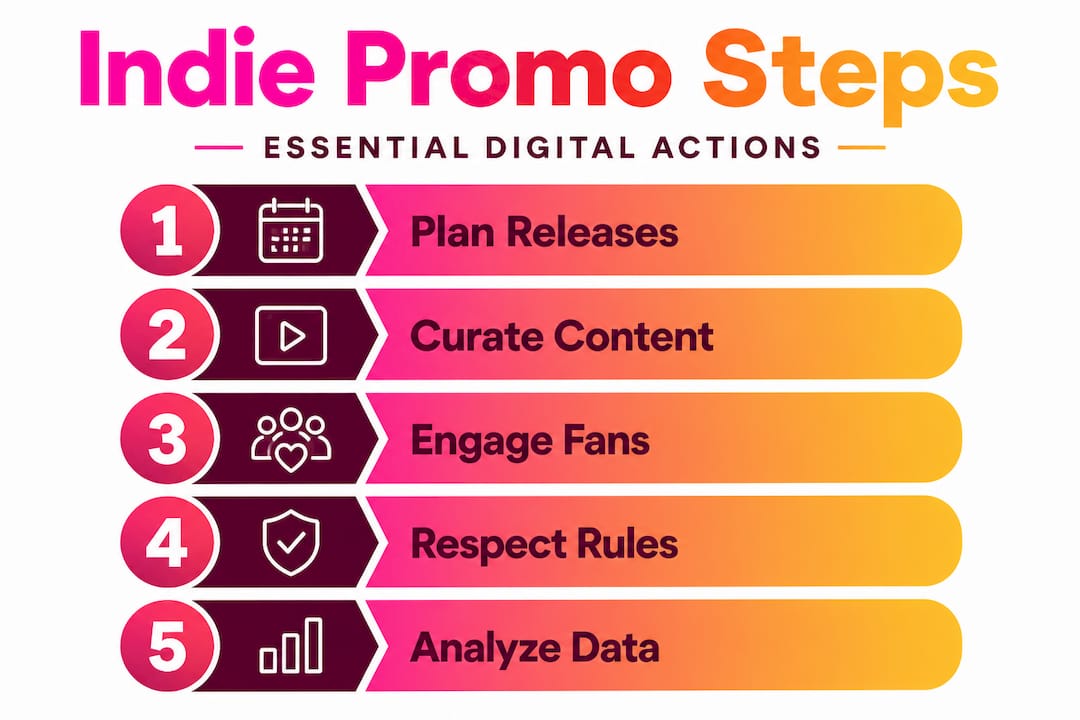
We have observed patterns across countless independent artists over the years, and the ones who build sustainable, growing audiences share one common characteristic. They treat promotion as a discipline rather than an event. They show up consistently, adapt based on data, and resist the urge to abandon a working strategy just because it feels slow.
The obsession with overnight success is understandable. Social media constantly surfaces stories of tracks that exploded from nowhere, and it is easy to believe those stories represent a reliable path. They rarely do. For every artist who went viral, there are thousands who did the same things and reached a fraction of the audience. What you never hear about are the years of consistent releases, community building, and careful platform management that preceded the moment of apparent overnight success for the artists who did break through.
The music marketing trends that actually deliver long-term results are the ones rooted in patience and repetition. Release schedules. Audience interaction. Optimised content. Legitimate advertising. These methods do not make for exciting stories, but they do make for careers.
“The artists who endure are the ones who understand that growth is not a moment. It is a practice.”
If you feel like your promotion is not working, the answer is rarely to try something more extreme. It is usually to become more disciplined about the fundamentals and give them more time to compound.
Next steps: Get your music seen and heard
You now have a clear picture of what digital music promotion involves, how release schedules drive momentum, and why staying within platform rules is non-negotiable. The next step is putting all of this into action without getting overwhelmed by the technical and creative demands.

That is exactly where Music Video Marketplace comes in. We help independent musicians create long-form videos in minutes, ready to upload directly to YouTube, and then launch ad campaigns for their songs without needing a marketing team or a big budget. If you are serious about turning these strategies into real audience growth, explore what Music Video Marketplace can do for your next release. From video creation to ad campaign setup, we handle the heavy lifting so you can focus on making music that matters.
Frequently asked questions
What is the difference between digital and traditional music promotion?
Digital music promotion focuses on online platforms, algorithms, and data-driven strategies, while traditional methods rely on radio airplay, physical media, and print press coverage. Digital promotion is more accessible to independent artists and provides measurable, real-time feedback.
Is it safe to buy Spotify streams for digital promotion?
No. Buying streams or followers violates Spotify’s Terms of Service and can result in your music being removed from playlists or your account being suspended, along with lasting damage to your algorithmic credibility.
How often should I release new music for maximum digital impact?
One single every six to eight weeks is widely recommended to maintain consistent audience engagement and keep platform algorithms active on your behalf.
Does YouTube promotion really help indie musicians?
Absolutely. Consistent YouTube activity combined with proper video optimisation, regular uploads, and cross-platform promotion can significantly increase both visibility and fan growth for independent artists over time.
Recommended
- Digital music promotion explained: proven strategies | Music Video Marketplace Blog
- Music promotion strategies for indie artists on YouTube | Music Video Marketplace Blog
- Digital marketing for producers: grow your audience fast | Music Video Marketplace Blog
- Music industry marketing explained: strategies for indie artists | Music Video Marketplace Blog
Read next
 What is long form music content: a 2026 guideDiscover what long form music content is and how it engages audiences. Learn its benefits for artists in our 2026 guide!
 What is long form video? A creator's guideDiscover what is long form video and how it can elevate your content strategy. Learn to engage audiences deeply and effectively!
 What is social proof in music: a guide for musiciansDiscover what social proof in music means and how it influences listener perceptions. Boost your career with effective strategies today!
 What is audio branding: a guide for marketersDiscover what is audio branding and how it shapes brand identity. Learn to leverage sound to enhance recognition and emotional connection.
Turn the idea into a finished music video.
Drop your track into the Studio and build your visual in minutes.