
What is a visualiser video? Essential guide for musicians 2026
Discover how visualiser videos work, their advantages over traditional music videos, and practical steps to create engaging visuals that amplify your music's reach in 2026.
What is a visualiser video? Essential guide for musicians 2026
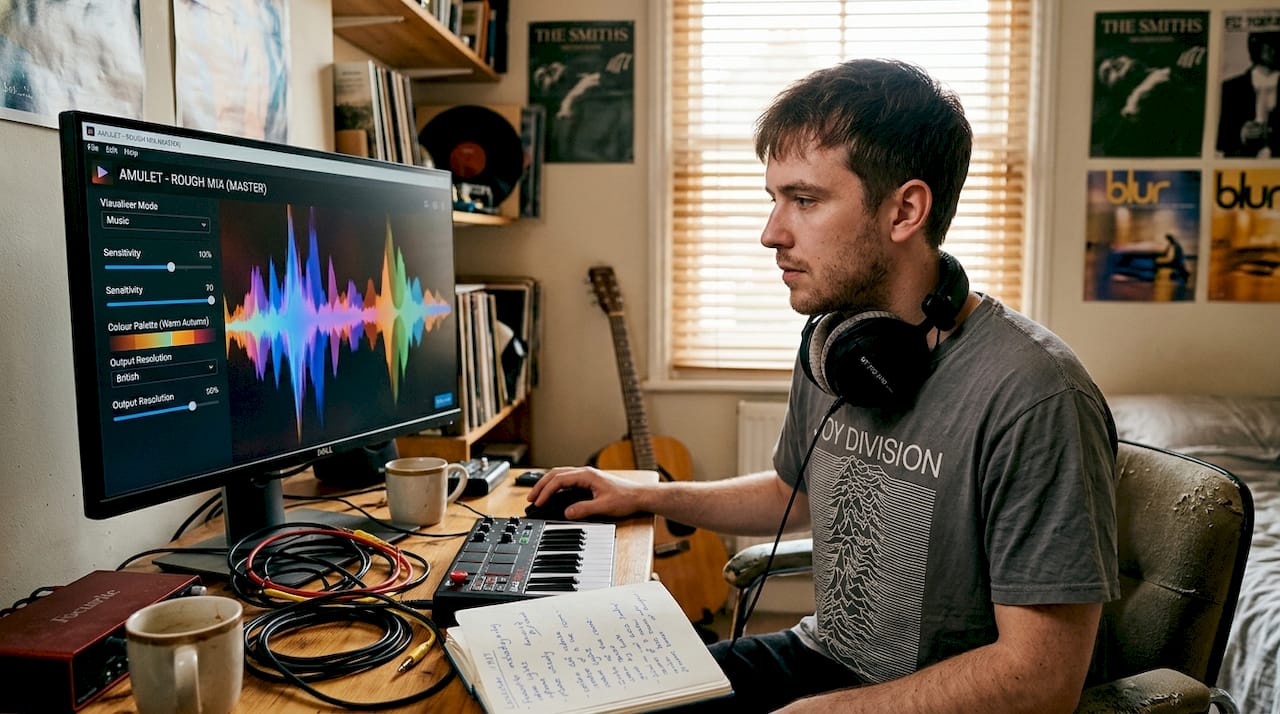
Many musicians dismiss visualiser videos as simple animations that add little value to their releases. This misconception overlooks their powerful role in modern music promotion. Visualisers combine audio-reactive technology with cost-effective production to create engaging content that performs exceptionally well across streaming platforms and social media. This guide reveals how visualisers work, their technical foundations, strategic advantages over traditional music videos, and practical steps to create compelling visuals that amplify your music’s reach in 2026.
Table of Contents
- What Is A Visualiser Video And How Does It Work?
- Understanding The Nuances: Strengths, Limitations And Genre Fit
- Visualiser Videos Versus Traditional Music Videos: Which To Choose?
- How Indie Musicians Can Create Effective Visualiser Videos In 2026
- Learn More And Get Started With Music Video Marketplace
Key takeaways
| Point | Details |
|---|---|
| Audio-reactive technology | Visualisers use FFT analysis to map frequency, amplitude, and tempo data to synchronised visual elements |
| Cost-effective promotion | Abstract animations provide affordable, quick-turnaround content compared to traditional filmed music videos |
| Platform optimisation | Looping visualisers excel on Spotify Canvas, TikTok, and YouTube Shorts with higher completion rates |
| Strategic sequencing | Start with visualisers to build audio engagement, then invest in narrative videos as your audience grows |
| Accessible creation tools | AI-powered platforms with templates enable artists to produce professional visuals without technical skills |
What is a visualiser video and how does it work?
A visualiser video is a simplified, computer-generated music video featuring abstract animations that react to audio elements using FFT analysis. Unlike traditional music videos with filmed narratives, visualisers create dynamic visual experiences through algorithmic interpretation of sound. They emerged from early media player visualisations in the 1990s and have evolved into sophisticated promotional tools that independent artists use to enhance their role of video in music promotion strategies.
The technical foundation relies on Fast Fourier Transform algorithms that analyse your track’s frequency spectrum, amplitude variations, and rhythmic patterns. Software analyses audio via frequency spectrum, amplitude, and tempo to create synchronised visuals. Bass frequencies typically drive larger, slower movements like pulsing circles or expanding shapes. Mid-range frequencies control colour shifts and particle density. High frequencies trigger rapid animations like sparks or quick flashes. This mapping creates the illusion that visuals are responding organically to your music.
Modern AI tools have revolutionised visualiser creation through stem separation technology. These platforms isolate drums, vocals, bass, and melodic elements, allowing each component to control different visual layers. Your kick drum might trigger a radial burst whilst your vocal line modulates colour gradients. This granular control produces more nuanced, professional results than older single-track analysis methods.
Key technical elements include:
- Frequency band mapping that assigns visual properties to specific audio ranges
- Amplitude modulation controlling intensity and scale of animations
- Tempo detection synchronising transitions to your track’s BPM
- Particle systems generating thousands of reactive elements
- Colour theory application matching visual palettes to genre aesthetics
The power of visualisers lies in their ability to transform abstract audio data into compelling visual narratives without requiring expensive production crews or location shoots.
Visualiser videos prioritise synchronisation and aesthetic appeal over storytelling. They create immersive experiences that keep listeners engaged on streaming platforms where visual content significantly impacts retention rates. For social media, these abstract animations perform exceptionally well because they capture attention quickly whilst allowing the music to remain the primary focus.
Understanding the nuances: strengths, limitations and genre fit
Whilst visualisers offer tremendous advantages, overcomplicating visuals can overshadow music rather than enhance it. Complex particle effects, excessive colour shifts, or overly busy animations distract listeners from your actual track. You want visuals that complement your music’s energy and mood without competing for attention. Testing your visualiser on multiple devices ensures smooth playback, as mobile phones process heavy 3D effects differently than desktop computers.
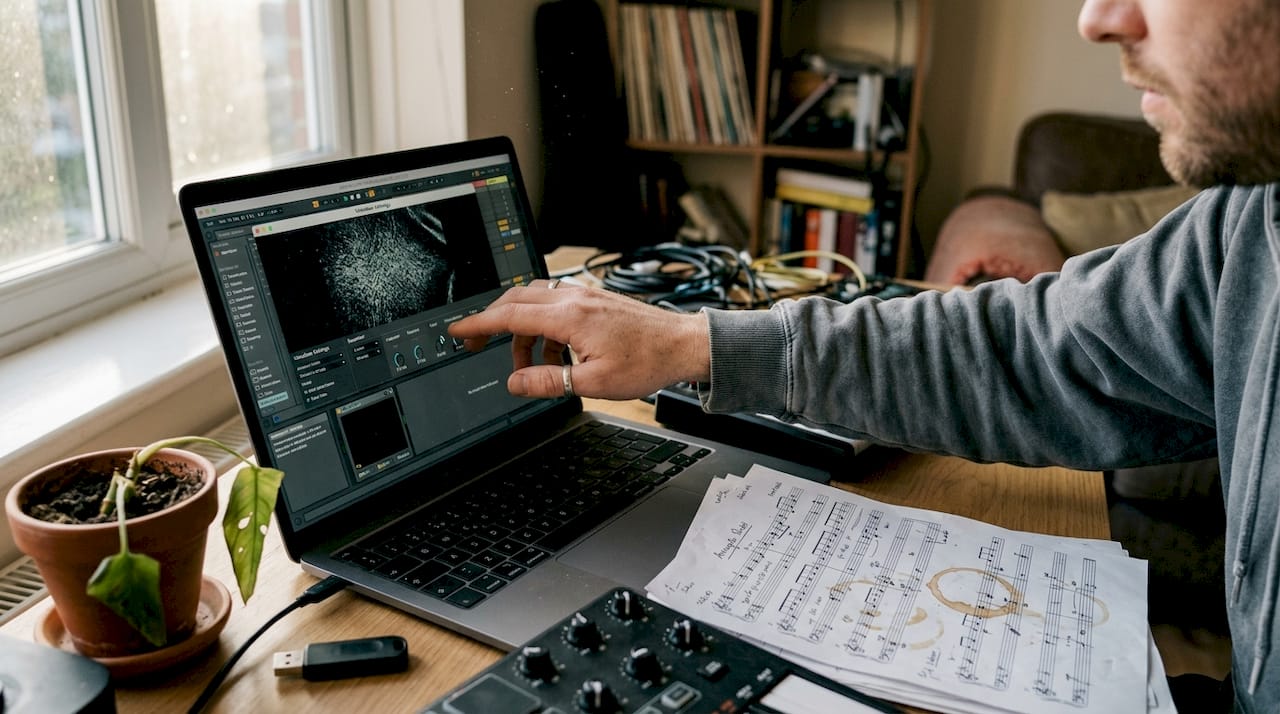
Genre matching dramatically affects viewer engagement. Electronic dance music thrives with vibrant, high-energy visuals featuring rapid colour changes and geometric patterns. Acoustic or ambient tracks benefit from subtle, flowing animations with muted colour palettes. Hip-hop visualisers often incorporate bold typography and urban-inspired graphics. Matching your visual style to listener expectations within your genre creates coherent branding and improves retention.
Technical considerations include:
- Frame rate optimisation ensuring smooth playback across platforms
- Resolution settings balancing quality with file size constraints
- Synchronisation accuracy preventing audio-visual drift
- Export codec selection for platform-specific requirements
- Compression levels maintaining visual fidelity whilst meeting upload limits
Manual adjustments often prove necessary even with AI-generated content. Automated systems excel at creating reactive patterns but lack artistic judgement about pacing and emphasis. You might need to reduce visual intensity during quieter verses or amplify effects during climactic choruses. Export settings require careful attention, as incorrect frame rates or codecs cause synchronisation problems that undermine the entire experience.
Pro tip: Render your visualiser at 1080p resolution with 60fps for optimal quality across platforms, but create a separate 720p version for faster mobile loading times and broader device compatibility.
AI tools demonstrate remarkable capability with abstract patterns and geometric designs but struggle with narrative precision or specific imagery requests. They generate endless variations of particles, waves, and fractals but cannot reliably produce recognisable objects or scenes. This limitation actually benefits most musicians, as abstract visuals maintain focus on the music rather than creating competing storylines.
Platform-specific use cases reveal where visualisers outperform traditional content. Spotify Canvas requires looping videos under eight seconds, making visualisers perfect for this format. TikTok’s algorithm favours content that maintains viewer attention through the entire duration, and visualisers’ constant motion achieves higher completion rates than static imagery. YouTube Shorts benefits from visualisers that work as standalone content whilst promoting your full track. Understanding these music video trends for indie artists 2026 helps you allocate resources effectively.
Visualiser videos versus traditional music videos: which to choose?
The strategic choice between visualisers and traditional music videos depends on your promotional goals, budget constraints, and audience development stage. Visualisers offer affordable, quick promotion with production timelines measured in hours rather than weeks. Traditional music videos require substantial investment in crews, equipment, locations, and post-production but deliver emotional storytelling that creates deeper audience connections and viral potential.
| Feature | Visualiser videos | Traditional music videos | | — | — | | Production cost | £50-£300 monthly subscription | £2,000-£50,000+ per video | | Timeline | Hours to days | Weeks to months | | Viewer completion | 70-85% average | 45-60% average | | Emotional impact | Moderate, aesthetic focus | High, narrative connection | | Viral potential | Low to moderate | Moderate to high | | Platform fit | Spotify, TikTok, Shorts | YouTube, Instagram, Facebook |
Completion rates favour visualisers because their constant motion and synchronised elements maintain attention without requiring narrative comprehension. Viewers can enjoy visualisers whilst multitasking or using music as background content. Traditional videos demand active watching to follow storylines, leading to higher drop-off rates amongst casual listeners. However, music videos that resonate emotionally generate significantly more shares, comments, and organic reach.
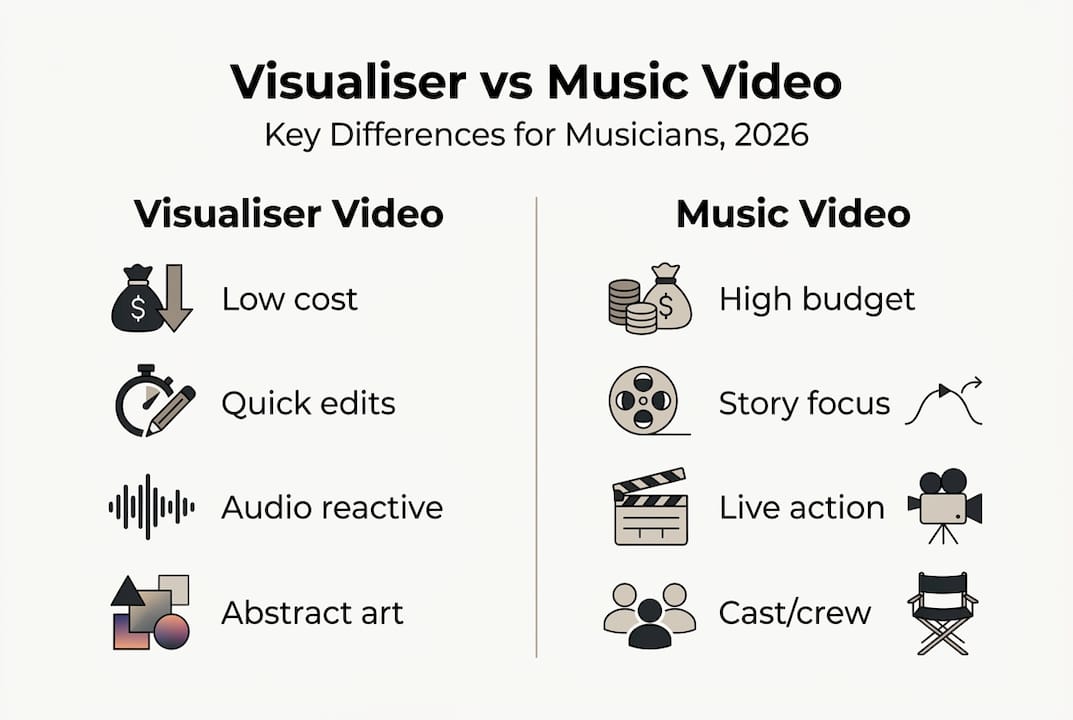
Sequential deployment maximises both formats’ strengths. Release a visualiser immediately upon track launch to establish visual presence across streaming platforms and social media. This builds initial momentum and audio engagement without major financial commitment. As your track gains traction and you accumulate data about audience demographics and preferences, invest in a traditional music video that targets your core fanbase with compelling storytelling. This approach optimises budget allocation whilst maintaining consistent visual content throughout your release cycle.
Pro tip: Analyse your streaming data to identify which tracks generate the most saves and playlist additions, then prioritise those songs for traditional music video production whilst using visualisers for catalogue tracks and B-sides.
Budget considerations extend beyond production costs. Traditional videos require marketing spend to achieve meaningful reach, as organic discovery on YouTube has become increasingly challenging. Visualisers integrate seamlessly into existing streaming and social platforms where your music already appears, reducing additional promotional expenses. For emerging artists with limited resources, visualisers provide professional visual content that enhances rather than drains promotional budgets.
Platform algorithms treat these formats differently. YouTube’s recommendation system favours longer watch times and engagement metrics that traditional videos can achieve through compelling narratives. Spotify’s Canvas feature specifically requests short, looping content where visualisers excel. TikTok’s discovery page prioritises eye-catching motion and audio synchronisation, making visualisers ideal for this platform. Understanding these nuances helps you deploy each format where it delivers maximum impact.
Scenarios where visualisers outperform include single releases with limited budgets, catalogue content requiring visual updates, playlist pitching that benefits from Canvas submissions, and social media campaigns focused on audio discovery rather than artist branding. Traditional videos prove superior for lead singles from albums, establishing artist identity and aesthetic, creating shareable moments that drive viral growth, and benefits of investing in music videos for long-term career development.
How indie musicians can create effective visualiser videos in 2026
Creating professional visualisers requires selecting appropriate tools, following systematic production workflows, and optimising output for platform-specific requirements. Indie artists should prioritise template and AI tools that offer stem separation, genre-specific presets, and intuitive interfaces. Platforms like Neural Frames, Renderforest, and VEED provide monthly subscriptions under £30 with sufficient features for high-quality output. These services eliminate technical barriers whilst delivering 70% plus viewer retention rates when properly configured.
Follow this systematic creation process:
- Export your final mixed track as a high-quality WAV or FLAC file to ensure accurate frequency analysis
- Select a template or visual style matching your genre and track energy level
- Upload your audio file and allow the platform to analyse frequency and tempo data
- Customise colour schemes, particle density, and animation intensity to align with your brand aesthetic
- Preview the visualiser at multiple timestamps to verify consistent quality throughout the track
- Adjust synchronisation settings if visual reactions lag or precede audio events
- Export at platform-specific resolutions and formats for optimal playback
- Test the final file on mobile devices before publishing to identify performance issues
Genre-appropriate styling significantly impacts engagement. Electronic producers benefit from high-contrast geometric patterns with rapid colour cycling. Singer-songwriters should choose flowing, organic animations with warm colour palettes. Rock and metal artists often favour darker themes with aggressive particle movements. Hip-hop visualisers work well with bold typography integration and urban-inspired graphics. Matching visual language to genre expectations creates immediate recognition and improves retention.
A/B testing different visual approaches reveals what resonates with your specific audience. Create two or three variations with distinct colour schemes or animation styles, then deploy them across different platforms or audience segments. Monitor completion rates, shares, and engagement metrics to identify which approach performs best. This data-driven method eliminates guesswork and optimises future visualiser production.
Distribution strategy matters as much as creation quality. Upload your visualiser to YouTube as the official audio version, enabling it to appear in search results and recommendations. Submit the video to Spotify Canvas for in-app playback during streaming. Create shortened, looped versions for TikTok and Instagram Reels that highlight your track’s hook or chorus. Cross-reference your visualiser strategy with comprehensive using visualizers for music promotion techniques to maximise reach.
Pro tip: Leverage automation for baseline visual generation but manually adjust key moments like song intros, choruses, and breakdowns to create memorable visual peaks that enhance your track’s structure and emotional arc.
Budget management involves balancing subscription costs against production volume. Monthly plans suit artists releasing content regularly, whilst annual subscriptions offer savings for consistent creators. Avoid overcomplicated effects that increase rendering times without proportional quality improvements. Focus resources on colour accuracy, smooth animations, and reliable synchronisation rather than excessive particle counts or complex 3D elements.
Export settings require platform-specific optimisation. YouTube accepts 1080p or 4K resolution with H.264 codec and AAC audio. Spotify Canvas demands vertical 9:16 aspect ratio under eight seconds with looping compatibility. TikTok performs best with 1080x1920 resolution and file sizes under 50MB. Instagram Reels requires similar specifications with particular attention to the first three seconds capturing attention. Consult each platform’s technical requirements before final export to avoid quality degradation or upload rejection.
Learn more and get started with music video marketplace
Transforming your music with compelling visuals becomes straightforward when you access the right resources and guidance. Music Video Marketplace serves as your comprehensive hub for creating, marketing, and distributing visual content that amplifies your releases. Whether you need budget-friendly visualiser creation tools or strategic advice on video marketing campaigns, our platform connects independent artists with actionable insights and professional services.
Explore our extensive collection of guides covering everything from technical production workflows to platform-specific optimisation strategies. Our music video marketing guide provides detailed frameworks for maximising your visual content’s impact across streaming services and social media. Start creating impactful music visuals today that engage listeners, increase retention, and build your audience effectively.
FAQ
What is the difference between a visualiser video and a music video?
Visualiser videos use abstract, audio-reactive animations that synchronise with frequency and amplitude data from your track. Traditional music videos feature filmed footage with actors, locations, and narrative storytelling. Visualisers cost significantly less and produce faster, making them ideal for immediate releases and catalogue content. Music videos require substantial production investment but create emotional connections and viral potential through compelling narratives.
Can I create a visualiser video without professional software skills?
Many platforms offer templates and AI automation that simplify visualiser creation for artists without technical backgrounds. Affordable subscription tools provide intuitive interfaces where you upload audio files and customise visual elements through simple controls. These easy visualiser creation tools eliminate coding requirements whilst producing professional-quality output suitable for streaming platforms and social media.
Which platforms benefit most from visualiser videos?
Spotify Canvas, TikTok, and YouTube Shorts represent ideal platforms for visualiser deployment. Canvas requires short, looping content that visualisers provide perfectly. TikTok’s algorithm favours constant motion and audio synchronisation that maintains viewer attention. YouTube Shorts benefits from standalone visual content that promotes your full track. Looped animations help maintain listener engagement and increase retention across all these platforms. Learn more about using visualisers on YouTube to optimise your promotional strategy.
How long should my visualiser video be?
Your visualiser should match your full track length for YouTube uploads, typically ranging from two to five minutes. For Spotify Canvas, create an eight-second looping segment that captures your song’s essential energy. TikTok and Instagram Reels perform best with 15 to 60-second excerpts highlighting your track’s hook or most engaging section. Platform-specific versions maximise each channel’s algorithmic preferences and user behaviour patterns.
Do visualiser videos improve streaming numbers?
Visual content significantly increases listener retention and engagement across streaming platforms. Tracks with Canvas visuals on Spotify show measurably higher save rates and playlist additions compared to audio-only releases. YouTube’s algorithm favours videos with strong watch time metrics, helping visualisers improve your track’s discoverability. Social media platforms prioritise video content in feeds and recommendations, extending your music’s reach beyond audio-only distribution channels.
Recommended
- Examples of video content for musicians in 2026 | Music Video Marketplace Blog
- 7 Essential Types of Music Video Formats for Musicians | Music Video Marketplace Blog
- Boost your music promotion with visuals on YouTube in 2026 | Music Video Marketplace Blog
- Why video content matters for musicians in 2026 | Music Video Marketplace Blog
Read next
 Best YouTube export settings for creators and editorsMaster YouTube export settings for the best video quality. Use MP4 with H.264 and AAC for stunning uploads that stand out.
 YouTube Shorts specs: the complete technical spec sheetDiscover the key YouTube Shorts specs: aspect ratio, resolution, format, and more to optimize your videos for maximum engagement.
 Get Your Song Into Upload Ready Video in Days for Music ProfessionalsRelease-ready workflow for music professionals: license a full length, ad ready video, drop in your master, and export platform specific short clips in days.
 What is long form video? A creator's guideDiscover what is long form video and how it can elevate your content strategy. Learn to engage audiences deeply and effectively!
Turn the idea into a finished music video.
Drop your track into the Studio and build your visual in minutes.