
Music Video Concept Ideas That Fit Your Song
Music video concept ideas for artists, labels and managers: unique, cinematic, animated and abstract directions, plus how to pick one that suits your song and budget.

Music Video Concept Ideas That Fit Your Song
The best music video concept is one visual idea that is specific to your song, simple enough to describe in a sentence and strong enough to carry the whole running time. You do not need a big crew to get there. You need a clear idea, a way to tie it to the track, and a plan for where the video will be released. For artists, labels and managers who want a finished, human-made video without organising a shoot, we built Music Video Marketplace so you can pick a concept that already exists, add your audio and branding, and release it.
MusicvideomarketplaceBring Your Song to YouTubeMusicvideomarketplace helps musicians create a long-form video in minutes to upload to YouTube and create an ad campaign for their song.VisitTL;DR
- A strong concept is one idea tied to the song’s hook, mood or lyric. If it takes a paragraph to explain, simplify it.
- Unique ideas are usually constraints: one location, one take, one repeated object, one rule.
- Cinematic, animated and abstract concepts are three different jobs: story, style and sensation. Choose by what the song needs, not by what looks impressive.
- Plan the release alongside the concept: a full-length YouTube cut, vertical clips and a looping visual all start from the same idea.
- If you want a finished professional video quickly, a customisable ready-made video removes the shoot and the edit from the path.
Table of Contents
- What makes a music video concept work
- Unique music video ideas that work on any budget
- Cinematic music video ideas
- Animated music video ideas
- Abstract music video ideas
- How to choose a concept for your release
- Our view: the concept is the easy part, finishing is not
- Get a finished video in minutes
- FAQ
- Sources
What makes a music video concept work
A concept is the central idea that links your music to the images: a story, a mood, a single striking visual or a performance style. It does not have to follow the lyrics literally. Ryan Tolleson’s guide makes the point that visuals can support a song through mood, contrast, symbolism or movement, as long as any symbol (a repeated object, a colour, a wardrobe change) connects back to what the song feels like and does not seem random.
The academic view is consistent with this. In a 2019 piece for Flow, Laurel Westrup argues that music has to drive the images for a work to read as a music video. She cites the idea of “synchronisation points”: moments where an edit, a camera move or an on-screen action lands on a rhythm or a lyric. Her example is Michel Gondry’s video for Daft Punk’s Around the World, where five types of character are choreographed to five musical voices. The idea is easy to state and every frame serves it.
Film scholar Collin Chua describes the relationship in two directions: the images add value to the music, and the two fuse into one experience. That is a useful test for any idea you are weighing. If you muted the track, would the visuals still feel connected to it? If you removed the visuals, would the song lose something?
A three-question filter
Before you commit to a concept, run it through these:
- Can you say it in one sentence? “A dancer returns to the same empty room at every chorus” works. A paragraph of backstory does not.
- Does it grow with the song? The idea should change when the song changes: a verse, a drop, a key shift. A concept that looks the same at 0:20 and 2:50 will feel long.
- Can you deliver it with what you have? The most workable concepts rely on one location, one setup and one rule. That keeps the idea about the song and not about the logistics.
Unique music video ideas that work on any budget
Originality rarely comes from spending more. It comes from a constraint that gives the video a clear shape. These formats suit independent artists, producers and DJs because each can be described in a line and executed cleanly.
- One take, one light. Perform the full song in a single unbroken take lit by a single lamp. Placing the lamp slightly in front and to one side gives the face shape without a flat, front-on look, as MusicMinutes suggests in its at-home list.
- Handwritten lyrics from above. Film the lyrics being written line by line from directly overhead, using window daylight so the hand does not throw a hard shadow. It suits lyric-forward songs and reads well on a phone.
- The repeated object. One prop, colour or gesture returns at each chorus and changes slightly each time. It gives the viewer something to track without needing a script.
- The single location with a twist. A kitchen, a car park or a rooftop where the lighting or the arrangement of people changes as the song builds.
- Archive and phone footage graded as one piece. Mixed-format material feels cohesive when one colour treatment is applied across it, which suits nostalgic or personal songs.
The common thread is a limit that is chosen on purpose. When viewers can see the rule, they read it as a decision and not as a shortcut.
Keep the real-world proof in mind
The UK duo LOOK MUM NO COMPUTER’s Eurovision video is a good model. According to LBB’s interview with the director, it was made in three weeks with no time for visual effects, so as much as possible was done in camera, with simple sets and props from the duo’s own museum. The visual ideas stayed close to the lyrics but were exaggerated or subverted. A tight deadline became the concept’s character.
Cinematic music video ideas
“Cinematic” is about story and atmosphere, not about a big budget. It means the video has a point of view: framing, light and pacing that pull the viewer into a world. Three directions work especially well.
The narrative micro-drama
A short story with a beginning, a turn and an end, told across the length of the song. The simplest and safest version is a performance-narrative hybrid: you perform the song in one setting while a small story plays out around you. It gives you the energy of a performance and the emotional hook of a story, and it is far easier to cut than a pure drama.
Directors who favour narrative tend to use longer pacing and fewer cuts. A UK guide on directorial styles, Hot Board, notes this approach suits artists who want a short film that lives beyond the usual streaming cycle, and that it can also score better with festivals and press.
Setting as character
Locations tell the viewer who someone is before a word is sung. Super Scout Pro points out that a humble apartment suggests an ordinary, relatable character, while a mansion suggests wealth and the high life, and that interiors can signal different eras or cultures. If your song is about status, nostalgia or isolation, the place you choose can carry half the meaning.
A concept that mirrors the lyric
Creative COW’s case study of the sci-fi video Cozey shows the principle well. In the write-up, a spaceman is lured through a jungle by a floating red diamond, hypnotised into removing his suit and ends up singing, catatonic, in a spiderweb. It is matched to a song about seduction and the willingness to be seduced. The visuals are fantastical, but the emotional logic is the song’s.
Animated music video ideas
Animation is the right choice when the song’s world cannot be filmed, or when you want a distinctive look that belongs only to the release. The question is not which style is fashionable but which one fits the track.
| Song type | Animation direction that tends to suit it |
|---|---|
| Folk, acoustic, singer-songwriter | Hand-drawn, textured, imperfect line work |
| Electronic, dance | Sleek motion graphics, particles, geometric forms |
| Hip-hop, R&B | Bold stylised characters or striking typography |
| Instrumental, ambient | Abstract animation where atmosphere leads |
This pairing follows the guidance in Educational Voice’s guide to animation for music videos, which also notes that character-driven animation builds emotional connection, while abstract animation suits instrumentals.
Two practical ideas stand out for independent releases:
- The returning scene. A character comes back to the same doorway at every chorus: first unable to knock, then reaching and stopping, finally opening it. Move Animation uses this exact structure as an example of developing one idea across repeated sections.
- Kinetic typography on the hook. Words that move with the hook work well for vertical formats, because the lyric itself becomes the visual and the clip reads without sound.
Whatever the style, rough out the timing against the track before committing to the finished look. Move Animation recommends playing a timed animatic with the song to hear which moments need more room. The same habit works for live-action ideas too: a storyboard with timestamps shows quickly where a concept runs out of ideas.
Abstract music video ideas
Abstract videos suit instrumental, electronic and atmospheric tracks, and songs whose lyrics are impressionistic. The image does not explain the song; it behaves like the song.
- Light painting. For Floating Points’ Silhouettes, Dezeen reported that long-exposure photography and a three-axis computer-controlled machine drew abstract shapes that flicker, grow more complex and paint the melodies across an arid landscape.
- Layered portraits. Dezeen also covered Kevin McGloughlin’s ‘digi-cut’ technique for Shit Robot’s End of the Trail. Layers of photographs and video of the singer’s face are stacked and sliced back to front, with coloured geometric shapes flickering across the portrait.
- Beat-animated light. In KINEMUS’s Je Pars, Directors Notes describes abstract lights animated straight ahead to the beat, inspired by early abstract film-makers, with camera movements keyframed to the rhythm.
The lesson for your own release is the same across all three: choose one visual language (light, layers, shapes, colour fields) and let the song’s rhythm drive how it moves. Abstract does not mean random.
How to choose a concept for your release
Match the concept to the job the video has to do, and to the way people will first meet it.
| If your priority is | Lean towards |
|---|---|
| A lyric-led song to be heard closely | Handwritten or typographic lyric visuals, a performance-narrative hybrid |
| Building a visual identity for an artist | A repeated object or colour world, one location with a twist |
| Festival, press or longevity | A narrative or cinematic short with slower pacing |
| Instrumental, DJ or producer releases | Abstract light, loops or motion graphics |
| Fast release with a tight schedule | A finished video you customise with your own audio and branding |
Plan the cut-downs from day one
A concept should travel. Start from the song’s strongest hook and build the idea around it, then plan the versions you will need: a full-length cut for YouTube, short vertical clips for social media and a looping visual. BrightWolf’s practical tips make the same recommendation to plan vertical, short-form and long-form edits at the start. If you are releasing on Spotify, our Spotify Canvas and lyric video guide covers the looping visual specifications.
Common mistakes
- Too many ideas. Three concepts in three minutes read as none.
- Symbols with no anchor. If a recurring image does not tie to the song’s emotion, it looks arbitrary.
- A concept bigger than the schedule. Weather, permits and availability can sink a plan that was fine on paper. A concept that works in one location with a small cast is far more likely to finish.
- Ignoring the first ten seconds. Open on the visual idea straight away so the viewer understands the rule of the video early.
Our view: the concept is the easy part, finishing is not
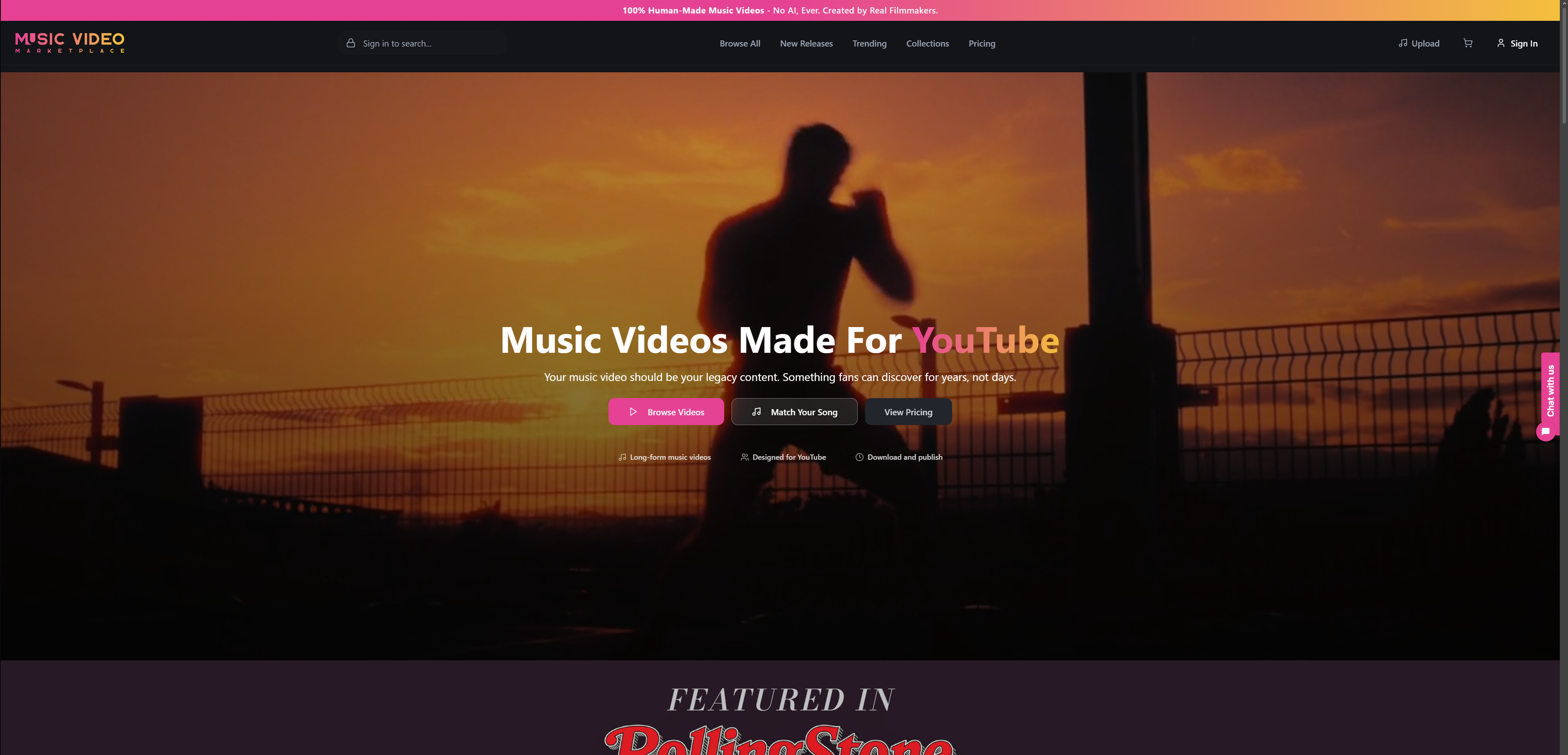
Most artists we talk to have a good idea for a video. What stops them is everything after the idea: finding the crew, booking the location, editing, and then cutting the result into clips for ads and social media. That is why we built Music Video Marketplace around finished, ready-to-edit, full-length videos.
Every video in our catalogue is originally produced by professional filmmakers specifically for music. It is human-made, never created with AI and never assembled from generic stock footage. You upload your audio and branding, customise it, and export a YouTube-ready video, then generate short social clips and launch an ad campaign for your song.
We think a concept earns its place when it fits the song and gets released. For a producer with a deadline, a label with a roster, or a manager with several artists, a customisable video that is already shot can be that concept, without a custom shoot.
Music
Get a finished video in minutes
If one of the directions above suits your track, you can browse human-made, full-length music videos on our music video catalogue, add your audio and branding, and export a video ready for YouTube. Membership is £19.99 per month, and each recurring extra video is £9.99 per month per video; see the pricing page for what each includes. For a closer look at why purpose-made footage matters, read our comparison of stock footage and custom video.
FAQ
What is a conceptual music video?
It is a video built around an idea, mood or style, not around a literal performance or a story that follows the lyrics. It can use symbolism, montage, surreal imagery or unusual editing. The test is whether the idea is connected to the song’s emotion and whether it can be summed up in one sentence.
What are the main types of music video?
The three most common are performance, narrative and concept. Many successful videos combine them: a performance-narrative hybrid keeps the artist on screen while a small story unfolds around them. Which one suits you depends on the song, the artist’s brand and how the video will be distributed.
How do I make a music video concept feel unique?
Add a constraint and commit to it: one take, one location, one repeated object or one visual effect. A rule that is clear to the viewer feels like a decision and not a limitation. Then tie it to the song’s hook so the idea could not be swapped onto another track.
Do I need a big budget for a cinematic video?
No. Cinematic quality comes from framing, light, pacing and a clear point of view. Single-location stories, one continuous camera move and careful lighting all work at modest scale. If you want professional filmmaking without a shoot, a customisable ready-made video from our catalogue gives you that finish with your own audio and branding.
Sources
- Getting in Synch with Music Videos, Laurel Westrup, Flow
- (https://epress.lib.uts.edu.au/journals/index.php/TfC/article/download/1066/1069)
- Capturing the Chaos in LOOK MUM NO COMPUTER’s DIY Eurovision video, LBB
- Light painting illuminates Floating Points’ Silhouettes, Dezeen
- Kevin McGloughlin uses digi-cut for Shit Robot music video, Dezeen
- Je Pars by KINEMUS, Directors Notes
- Expansive Sci Fi Music Video Cozey, Creative COW
- How to Turn Your Song Into a Cinematic Music Video Concept, Ryan Tolleson
- 15 Music Video Ideas You Can Make at Home, MusicMinutes
- Hot Board: Music Video Directorial Styles (UK Guide)
- 12 inspiring music video ideas, Super Scout Pro
- Animation for Music Videos: A 101, Educational Voice
- Animated music videos: let the song and story meet, Move
- Innovative concepts for music videos, BrightWolf Films
Recommended
Read next
 How Much Does a Music Video Cost in the UK? 2026 BudgetsWhat a music video really costs in the UK in 2026: budget tiers from £500 to £20,000+, what drives the price, hidden extras and a £19.99 a month alternative.
 Music Video Deliverables: What to Hand Over and WhereA practical checklist of music video deliverables: master file, social cutdowns, specs, rights paperwork and metadata, for UK artists, labels and managers.
 Music Video File Naming: A Practical Guide for ArtistsHow to name music video files for Vevo, YouTube and distributors: a clear format, version tags, folder structure and mistakes to avoid, with examples.
 Lyric video creation process: your 2026 guideDiscover the lyric video creation process in 2026. Learn to sync visuals and lyrics quickly and effectively for music promotion across platforms.
Turn the idea into a finished music video.
Drop your track into the Studio and build your visual in minutes.